

Chip stocks lost close to 10% in six sessions after one OpenAI revenue report, yet TSMC says AI demand still outruns supply. Is the AI chip boom slowing?
Is the AI Chip Boom Slowing? What OpenAI’s Revenue Shows
One number was enough to shake the AI trade: USD 50 billion.
OpenAI’s annualized revenue was reported at roughly USD 50 billion at the end of September, around USD 20 billion below a figure that had previously circulated around the market. On October 8, the PHLX Semiconductor Sector Total Return Index fell roughly 3.4%, while Nvidia dropped 2.9% as doubts around AI profitability resurfaced.
It did not stop there. The index fell for six straight sessions to October 14, losing close to 10% and putting chip stocks on pace to shed more than USD 1 trillion in market value, according to Quartz.
At first glance, the conclusion looked obvious. If OpenAI, one of the most closely watched companies in artificial intelligence, was growing more slowly than expected, would it cut spending? Would demand for GPUs, memory and data centers follow? And after one of the most powerful semiconductor rallies in years, had the AI chip boom finally peaked?
These questions matter because AI remains one of the forces holding up the broader market despite tougher macro conditions, a tension we highlighted in D Prime’s Q4 2026 Market Outlook: 4 Key Signals Traders Watch.
But there was a catch. The missing USD 20 billion may say more about how private AI companies measure revenue, and which number the market was measuring against, than about a sudden collapse in AI demand.
So the real question is more interesting:
Is the AI chip boom actually slowing, or is the market entering a more demanding phase where growth alone is no longer enough?
The USD 20 Billion Gap Wasn’t What It Looked Like
The first problem is the number itself. Two things distorted it.
Annualized Revenue Is Not Booked Revenue
Annualized revenue is not the same as booked full-year revenue. It takes revenue generated over a shorter period and extrapolates it into an annual run rate, and private AI companies do not all calculate it the same way.
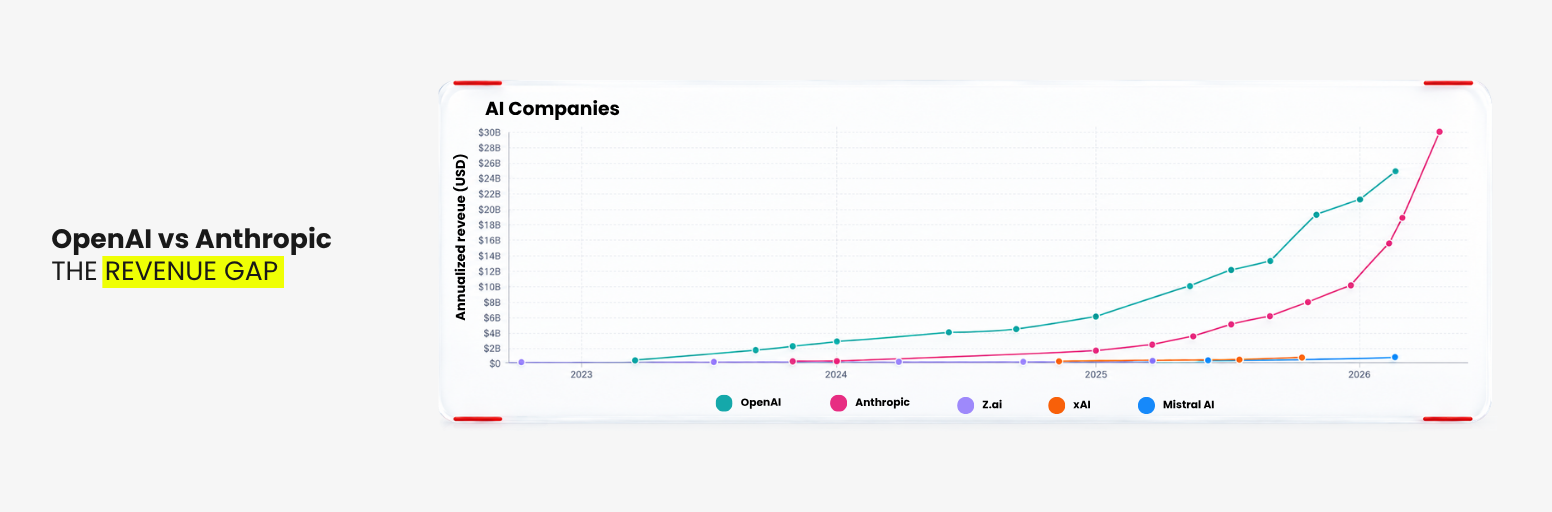
According to the Financial Times, OpenAI’s roughly USD 50 billion annualized net revenue excludes some proceeds generated through cloud partners, while Anthropic uses a broader measure that includes gross sales made through partners. Comparisons between the two companies are not apples to apples, and part of the gap came from different ways of presenting the numbers rather than from USD 20 billion of sales disappearing.
A Target Read as a Run Rate
There is a second reason not to read USD 50 billion as collapsing demand. OpenAI reportedly expects annualized revenue to reach or exceed USD 70 billion by the end of 2026, largely supported by continued enterprise growth.
That number deserves a second look. The figure the market had been carrying was also around USD 70 billion, which raises an obvious possibility: the missing USD 20 billion may not describe a shortfall at all, but a year-end target that had been read as a current run rate.
So the headline scare may have been exaggerated. The underlying concern was not.
OpenAI Is Still Growing. The Cost of Growth Is the Bigger Question
OpenAI’s quarterly numbers reveal a more important tension than the run-rate headline.
Revenue Up, Losses Wider
Revenue increased from USD 5.7 billion in Q1 to USD 6.7 billion in Q2, an increase of about 18%. But operating losses widened from USD 9.3 billion to USD 12.3 billion over the same period, according to reporting on OpenAI’s second-quarter financials.
These are booked quarterly figures, which is why they look small beside a USD 50 billion run rate. Q2 revenue of USD 6.7 billion annualizes to roughly USD 27 billion. One measures revenue already booked in a past quarter. The other is a snapshot of the exit rate at a single later point, and closing that distance in roughly a quarter implies a very steep ramp. That is part of why the market reacts so sharply to any revision in OpenAI’s run-rate disclosures.
The Capital Burn Question
OpenAI is still growing rapidly, but the cost of sustaining that growth is enormous. The company expects to spend around USD 50 billion on computing power in 2026, according to OpenAI President Greg Brockman.
That changes the question. The issue is no longer simply whether OpenAI can grow. It is how much capital it must burn to keep growing at the rate markets expect.
Why One Revenue Story Hit the Whole Chip Sector
OpenAI’s economics matter far beyond OpenAI itself, and the past week showed how quickly a concern about one company can travel.
OpenAI’s Spending Is the Chip Sector’s Revenue
The AI infrastructure boom follows a simple chain. More AI adoption creates more compute demand. More compute demand pushes AI labs and cloud providers to build capacity. And that capacity is bought as GPUs, memory, networking equipment, data centers and electricity.
D Prime highlighted this physical buildout in our 2026 Mid-Year Market Outlook: AI Leads. Liquidity Decides., where we argued that AI had moved beyond a software story into a much larger industrial and capital-expenditure cycle. In AI Infrastructure Boom: Are Optical Modules the Next Big Opportunity?, we looked at how that pressure was spreading into the networking and optical supply chain.
So if growth at OpenAI genuinely weakened, the concern would not stop at the company. It would travel upstream, which is why one revenue story was enough to move semiconductor stocks.
Rates and Insiders Added to the Pressure
The OpenAI report was not the only weight on the sector. On October 14, September CPI came in at 3.7% year over year, up from 3.4% in August, with energy prices up 5.2% on the month. Hotter inflation raised the odds of another Fed hike, and higher rates hit long-duration growth stocks hardest.
Industry voices turned cautious too. Speaking in Singapore on October 12, Broadcom CEO Hock Tan said “a lot of investors have no clue what they are investing in,” likening some AI investors to people in a casino, as reported by The Next Web.
There is evidence that the economics of AI are becoming more demanding. There is much less evidence that AI chip demand itself has collapsed.
The AI Chip Boom Is Cooling, Not Breaking
If the AI hardware cycle were rolling over sharply, weakness should be showing up in the industry’s own numbers. So far, it is not.
Chip Sales and Nvidia Are Still Accelerating
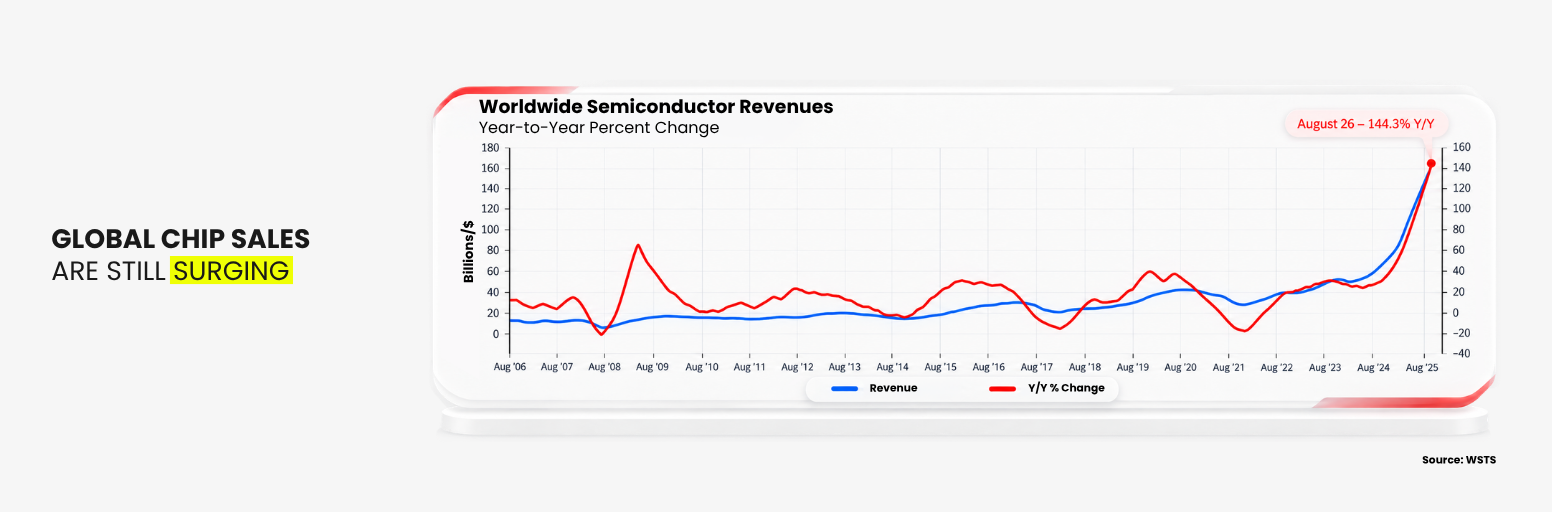
According to the Semiconductor Industry Association, global semiconductor sales reached USD 159.7 billion in August, up 8% month over month and 144.3% year over year. August marked the industry’s 18th consecutive month of year-over-year growth, and year-to-date sales passed USD 1 trillion for the first time.
Nvidia tells a similar story. The company reported USD 96.2 billion in revenue for its fiscal second quarter, up 18% from the previous quarter and 106% year over year, with its Data Center business alone generating USD 89 billion, up 117%, according to Nvidia’s official results.
TSMC Says Demand Still Outruns Supply
The newest data point is the strongest. On October 15, in the middle of the sell-off, TSMC reported third-quarter revenue of USD 46.72 billion, up 41.2% year over year in dollar terms, according to Crypto Briefing. Net profit rose 68.7%, and high-performance computing, which includes AI accelerators, made up 68% of revenue, according to TradingKey.
TSMC guided fourth-quarter revenue to USD 52.3 billion to USD 54.3 billion, about 58% higher than a year earlier at the midpoint. “The demand is extremely robust. We did not see any sign of slowdown,” CEO C.C. Wei said on the earnings call, adding that demand “is still far above our capability today to supply.”
TSMC’s US-listed shares still closed 3.4% lower. That is the clearest sign yet that the problem is expectations, not orders.
Memory Is Still Tight
TrendForce reported that DRAM industry revenue jumped 59.5% quarter over quarter in Q2 to nearly USD 154.73 billion, supported by higher prices and strong AI-server demand. Supplier inventories remained near historic lows, while new supply continued to lag demand.
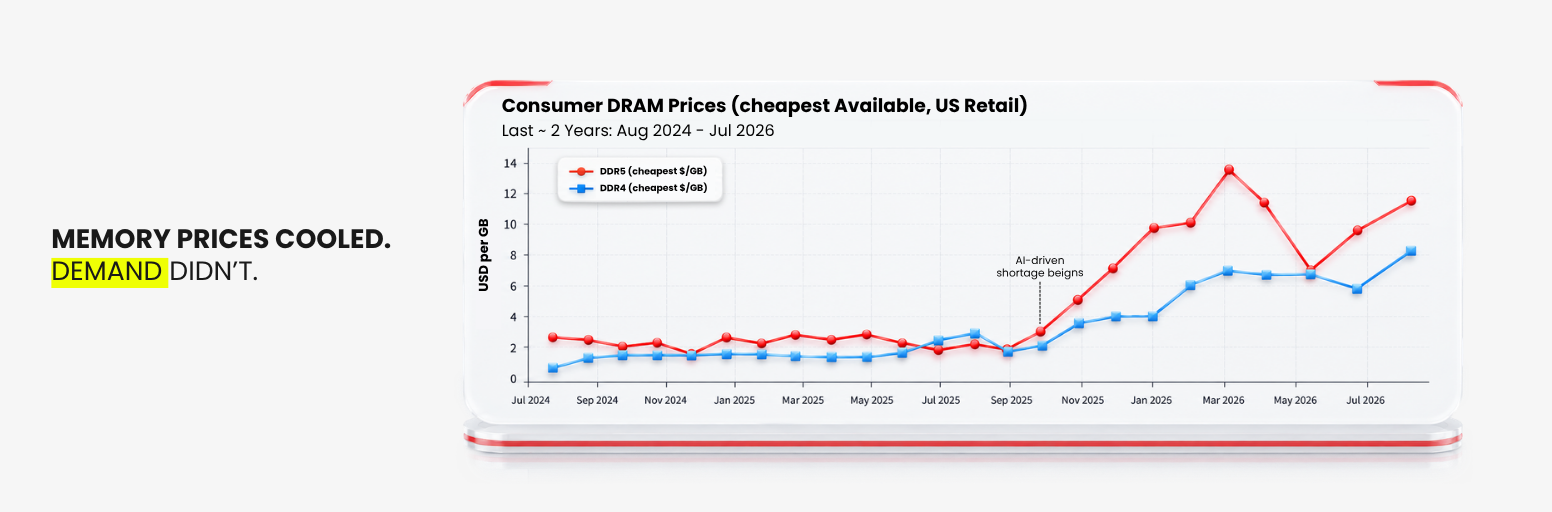
So why does the trade feel less straightforward? Because the rate of acceleration is changing.
The Easy Part of the AI Hardware Trade May Be Over
TrendForce expects conventional DRAM contract-price growth to moderate as supply gradually catches up. That does not mean demand has disappeared. It means the industry may be moving away from the most explosive phase of the cycle, when shortages and rising prices could lift revenue almost automatically.
That is what a maturing upcycle looks like. Growth slows first. The cycle does not necessarily end.
From Scarcity to Selectivity
In the earliest phase of the AI boom, the investment case was simple. More AI meant more compute, more compute meant more chips, and scarce supply meant rising prices. Much of the value flowed to semiconductor companies and infrastructure providers.
That dynamic still exists, but investors are becoming more selective. D Prime identified the shift at the start of the year in US Stocks Outlook 2026: Is the Rally Sustainable?, highlighting three factors for AI leadership: real revenue generation, infrastructure demand and earnings visibility. Those matter even more now. Supply can expand, margins can normalize, competition can intensify, and the capital needed to sustain the buildout can keep rising.
Higher borrowing costs add another hurdle. We explored how AI capital expenditure is competing for long-term funding in US Treasury Yields Spike: Why Buybacks May Not Stop the Bond Stress.
So has the semiconductor cycle peaked? On current data, not yet. But markets now react far more aggressively to small signs of slowing, and the question is shifting from how many chips does AI need? to what economic value is all that computing power creating? That brings the story downstream.
The Next Trade May Move Closer to the User
Every major technology cycle begins with infrastructure. Before the internet economy produced search engines, social networks and e-commerce, enormous amounts of capital first went into telecommunications equipment, servers and networking. AI has followed the same path, but infrastructure is not the final product. Eventually somebody has to use it, and more importantly, somebody has to make money from using it.
That transition is already challenging traditional software economics. Gartner estimates that as much as USD 234 billion of enterprise application spending, roughly 20% of SaaS spending, could be exposed to what it calls “agentic arbitrage” by 2030. If AI agents can complete tasks across several systems on their own, businesses may need fewer people working inside individual software interfaces, which weakens the per-seat pricing that SaaS was built on. Software companies may increasingly need to sell outcomes, workflows and measurable productivity rather than access.
Advertising Is Already Turning Compute Into Revenue
Advertising offers one of the clearest examples. Meta generated USD 59.36 billion in advertising revenue in Q2 2026, up 27% from a year earlier, according to Meta’s second-quarter results. At Alphabet, Google Search and Other revenue grew 17% while Google Cloud revenue surged 82%, according to Alphabet’s Q2 earnings update.
AppLovin’s second-quarter revenue reached USD 1.924 billion, up 53%, with net income of USD 1.267 billion and adjusted EBITDA of USD 1.614 billion, according to AppLovin’s Q2 2026 results.
AI infrastructure proves there is demand for compute. AI applications prove that compute can turn into cash.
What Should Traders Watch Next?
Four signals will help show whether the AI chip boom is turning or simply evolving, with the Fed’s October 27 to 28 meeting setting the rate backdrop for all of them.
OpenAI’s Revenue Trajectory
Whether OpenAI reaches its USD 70 billion year-end target will show whether October’s scare reflected genuine weakening or confusion over revenue methodology.
Hyperscaler Capital Spending
Late-October earnings from the large cloud providers are the next big test. A meaningful cut to capital expenditure plans would be a far stronger warning than one private company’s revenue estimate. So far, TSMC’s reaffirmed USD 60 billion to USD 64 billion capex budget for 2026 points the other way.
Semiconductor Pricing and Inventory
If memory prices weaken sharply while inventories build and shipments slow, the case for a genuine turn in the cycle becomes much stronger. Moderating price growth alone is different, because it can simply mean an extreme shortage is normalizing.
Downstream AI Monetization
Advertising, AI agents, cloud services and enterprise software need to show that the money invested in AI infrastructure can generate sustainable returns. The better they monetize AI, the stronger the case for continued upstream spending.
The AI Boom Is Not Ending. But the Easy Phase May Be.
OpenAI’s revenue scare, and the week-long chip sell-off that followed it, exposed how high expectations have become. Revenue is still expanding, chip demand remains strong and TSMC says it still cannot build fast enough. But simply saying “AI is growing” may no longer be enough.
The first phase of this cycle rewarded companies that could supply scarce computing power. The next may increasingly reward those that can turn that computing power into durable revenue and profit. That does not mean the upstream trade disappears overnight. It means the AI story is becoming more selective.
The question is shifting from who can build AI? to who can make money from it?
By D Prime Analysis Team
Macro and market strategy research by D Prime’s in-house analysis team.
Disclaimer
The information contained herein is provided for general informational and educational purposes only and does not constitute investment advice, financial advice, trading advice or any other form of professional advice, a recommendation, or an offer or solicitation to buy or sell any financial instruments or engage in any trading strategy.
Trading in leveraged products such as contracts for difference (CFDs) involves a significant risk of loss and may not be suitable for all investors. Past performance is not indicative of future results. Any references to market trends, asset performance, price levels, or forward-looking statements reflect opinions or general market commentary as at the date of publication and are subject to change without notice.
This article does not take into account any individual investor’s objectives, financial situation, or risk tolerance. Readers should conduct their own independent research and seek professional advice before making any investment or trading decisions. D Prime and its affiliates make no representations or warranties about the accuracy or completeness or reliability of this information and disclaim any and all liability for any direct, indirect, incidental, consequential, or other losses or damages arising out of or in connection with the use of or reliance on any information contained herein. The above information should not be used or considered as the basis for any trading decisions or as an invitation to engage in any transaction. Do not rely on this article to replace your independent judgment.
“D Prime” is a brand name of D Prime Vanuatu Limited, a company incorporated and regulated by the Vanuatu Financial Services Commission (Company Number: 700238). The availability of products and services may vary depending on jurisdiction and applicable regulatory requirements.