

When weighing an ECN vs STP account, the choice affects how your trading costs are structured and how your orders are handled.
The short answer: an ECN account usually pairs a tight or raw spread with a separate commission, while an STP account usually builds the broker’s charge into a wider spread with no separate commission. Neither is automatically cheaper or better. The right choice depends on the broker’s actual pricing, how much you trade and the execution conditions that apply to you.
This guide explains how ECN and STP accounts generally work, compares their costs and features, and shows what to check before funding an account, since brokers can implement these labels differently. If you are running a forex trading account type comparison across several brokers, the same checks can help you look beyond the account name and understand what you are actually getting.
What Is an ECN Account?
ECN stands for Electronic Communication Network.
In a traditional ECN structure, an electronic network brings together pricing and orders from multiple market participants and liquidity sources, such as banks, financial institutions and other traders.
For retail traders, the term ECN is also used to describe an account with very tight or raw spreads and a separate commission. The exact execution arrangement can differ between brokers, so the ECN label alone does not tell you precisely how an order is handled.
How ECN execution works
In a traditional ECN environment, bids and offers from multiple liquidity sources sit side by side in the network. When you place a market order, it is matched against the best available opposite price.
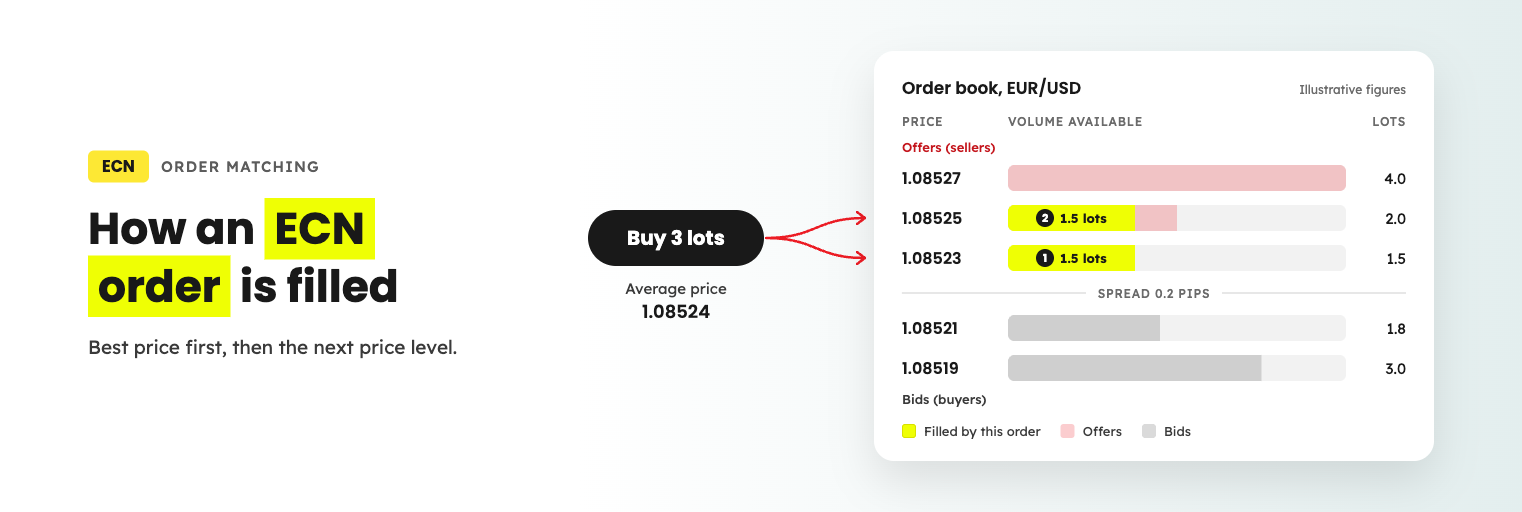
If there is not enough volume at that price to fill your whole order, the remainder is filled at the next available price levels. This is one reason larger orders can be filled at a slightly different average price from the one first quoted.
Some ECN accounts and trading platforms also provide market depth information, sometimes called Level II data. This shows available pricing and volume at different price levels, so traders can see how much liquidity sits around the current quote.
Market depth is not guaranteed simply because an account is called ECN. Whether it is available depends on the broker, the trading platform and the underlying execution setup.
What ECN pricing looks like
ECN accounts commonly combine tight or raw variable spreads with a separate commission.
During highly liquid trading periods, spreads on major currency pairs can become very tight. They can also widen when liquidity falls or volatility increases, including around major economic announcements or the daily rollover.
When comparing ECN accounts, check whether the commission is quoted:
- per side, meaning it is charged when opening and again when closing a position
- per round turn, meaning the quoted amount covers both opening and closing
A US$3.50 commission per side, for example, equals US$7 per round turn. Knowing which one is quoted stops two identical commission structures from looking very different.
What Is an STP Account?
STP stands for Straight Through Processing.
The term generally refers to automated order processing in which orders are routed electronically without manual dealer intervention. Depending on the broker’s execution arrangements, orders may be connected to one or more liquidity providers.
How STP order routing works
In a typical STP setup, an order follows a path like this:
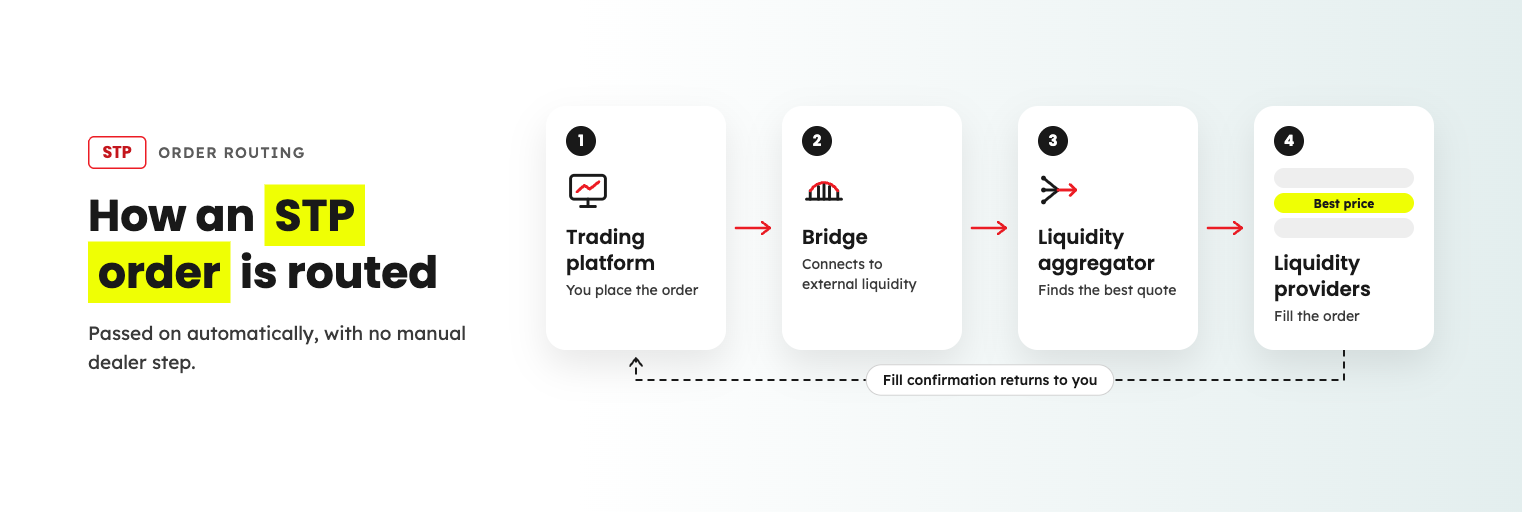
- You place an order on the trading platform.
- The broker’s systems pass it through a bridge, the technology that connects the trading platform to external liquidity.
- A liquidity aggregator compares quotes from the connected providers and routes the order to one offering the best available price.
- The provider fills the order and the confirmation returns to your platform.
The broker uses the pricing it receives from these providers to generate the prices displayed on its platform. Some liquidity providers apply last look, a short window in which they can accept or reject an order at the quoted price. Brokers should disclose whether this applies.
Unlike a traditional ECN, an STP account does not usually give traders a visible shared order book or Level II market depth.
What STP pricing looks like
STP accounts often use spread only pricing.
Instead of charging a separate commission, the broker may build its trading charge into the spread between the bid and ask prices. Some STP products use other pricing structures, so always check the broker’s published trading conditions.
The main advantage of spread only pricing is simplicity: there is no separate commission to add when estimating the basic cost of a trade.
Why ECN and STP labels don’t tell the whole story
ECN, STP and no dealing desk are common industry descriptions rather than universal regulatory classifications. The same label can describe different execution arrangements at different brokers.
A broker may act as principal or agent, use external liquidity providers, internalise certain transactions or operate under another arrangement, depending on its business model and legal documentation.
Treat the account name as a starting point rather than proof of how your order reaches the market. The broker’s order execution policy, terms of business and product specifications show how orders are actually handled.
ECN vs STP: Key Differences Compared
| Feature | ECN account | STP account |
|---|---|---|
| Pricing structure | Commonly raw or tight spreads plus commission | Commonly spread only |
| Spread | Variable; may start very low | Usually variable and may include a markup |
| Commission | Commonly charged separately | Often no separate trading commission |
| Market depth | May be available on supported platforms | Usually not displayed |
| Slippage | Possible in either direction | Possible in either direction |
| Execution speed | Depends on broker infrastructure and market conditions | Depends on broker infrastructure and market conditions |
| Cost calculation | Add spread and commission | Usually based mainly on spread |
The practical differences often come down to how trading costs are presented and what execution information you can see.
Spreads and commissions: two ways to pay
An ECN account commonly separates trading costs into a tight or raw spread plus a commission. An STP account commonly builds the trading charge into a wider spread.
Neither structure is cheaper by definition. To compare them properly, calculate the total cost of opening and closing a position rather than comparing the headline spread alone.
Slippage and execution speed
Slippage occurs when an order is executed at a different price from the price available when it was submitted. It can occur with both ECN and STP accounts and may be positive or negative.
Several factors can influence slippage, including:
- available liquidity
- market volatility
- order size
- execution speed and network latency
- the broker’s liquidity and execution arrangements
This is why claims that one account label always delivers faster execution or less slippage should be treated with caution. Execution quality depends more on the broker’s infrastructure and arrangements than on whether the account is called ECN or STP.
Market depth and transparency
Market depth can be one practical difference between the two account types.
Some ECN environments and supported platforms show available pricing and volume at different levels. For traders dealing in larger sizes, this can help them judge how much liquidity may be available around a quoted price.
For traders using smaller positions, total trading cost and execution quality may matter more than access to market depth.
Which Account Suits Your Trading Style?
Different trading styles place different weight on spreads, commissions, financing costs and execution.
The examples below describe common considerations rather than recommendations. The right account depends on your own objectives, strategy, trading volume and risk tolerance.
Scalping and high frequency strategies
Scalpers typically open and close positions frequently while targeting relatively small price movements. Because transaction costs take up a larger share of each potential outcome, spreads and commissions become particularly important.
Traders using these strategies often compare raw spread plus commission pricing against spread only accounts carefully. If you use scalping or automated strategies, also check:
- whether scalping is permitted
- whether Expert Advisors are supported
- minimum holding requirements, if any
- average spreads during the sessions you trade
- execution and slippage conditions
Intraday trading
Day traders normally open and close positions within the same trading session. Either account structure can suit this style, depending on actual costs.
Trading volume matters because even a small difference in cost per trade adds up over many trades. Instead of choosing based on the account label, estimate your total trading cost using your expected monthly volume.
Swing and position trading
Swing and position traders may hold positions for several days or longer. Over longer holding periods, the difference between spread and commission structures may be a smaller share of overall costs.
Overnight financing, or swap, can become more important when positions stay open across multiple trading days. Compare these charges alongside spreads and commissions.
Smaller balances and newer traders
Traders starting with smaller balances may focus more on minimum funding requirements, minimum position sizes and simple pricing. Some brokers also offer Cent accounts that allow smaller trading sizes.
A demo account can help you see how spreads, order execution and the trading platform behave before trading with real funds.
How to Check What You’re Actually Getting
Because account labels vary between brokers, look at the documentation behind an account and run the numbers before deciding.
Read the order execution policy
A broker’s order execution policy explains how your orders are handled. Look for information on:
- how orders are executed or routed
- whether the broker acts as principal or agent
- where prices are sourced
- the broker’s execution venues
- how slippage is handled
- whether external liquidity providers are involved
- how orders behave in volatile or illiquid conditions
Also check which legal entity you are opening an account with and which regulator supervises it. Products, protections and trading conditions may differ across jurisdictions.
Convert commission into pips
One useful way to compare account types is to express the main transaction costs in the same unit.
For EUR/USD, where USD is the quote currency, one pip on a standard lot (100,000 units) is worth approximately USD 10. A USD 7 round turn commission therefore equals approximately:
USD 7 ÷ USD 10 per pip = 0.7 pips
If the raw spread is 0.2 pips, the combined spread and commission cost becomes:
0.2 + 0.7 = 0.9 pips
You can then compare this directly with the spread on a spread only account. Actual costs may still be affected by slippage, financing charges and changing market spreads.
Worked example: EUR/USD costs compared
The figures below are hypothetical and for illustration only. They are not D Prime’s pricing, and live spreads vary with market conditions.
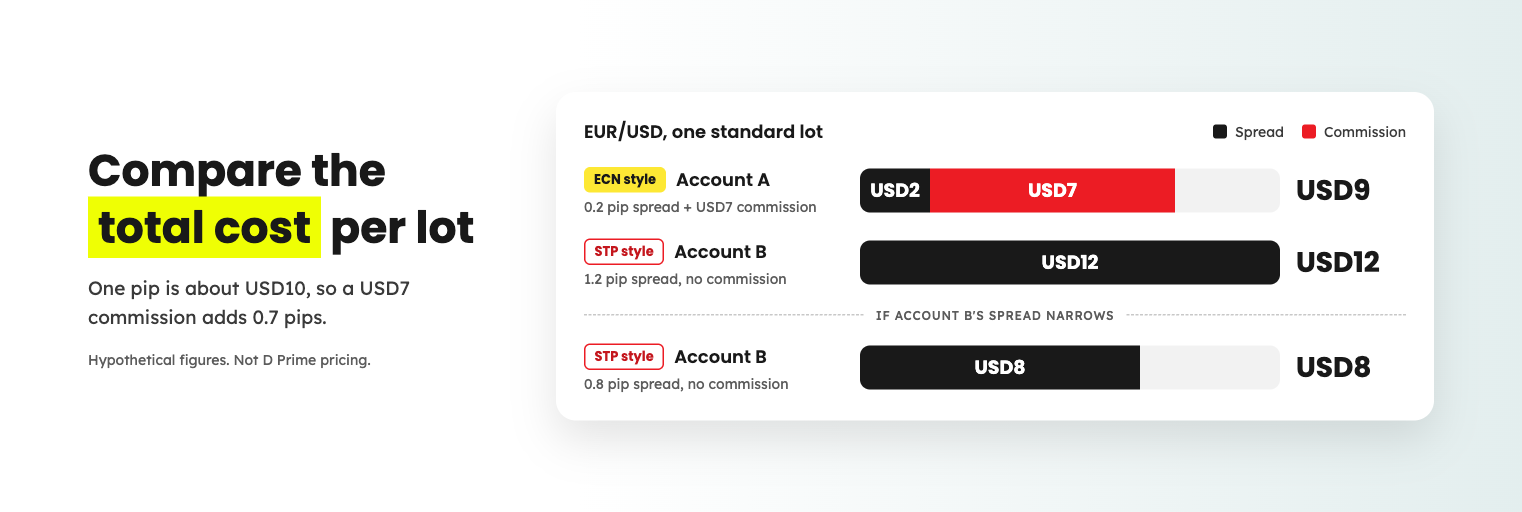
Account A, ECN style
- Average raw spread: 0.2 pips
- Commission: USD 3.50 per side (USD 7 per round turn)
Account B, STP style
- Average spread: 1.2 pips
- No separate commission
For one standard lot opened and closed:
- Account A: 0.2 pips × USD 10 = USD 2 spread cost, plus USD 7 commission = USD 9
- Account B: 1.2 pips × USD 10 = USD 12
At 20 standard lots, using the same assumed costs, Account A costs approximately USD 180 and Account B approximately USD 240. At two standard lots, the figures are approximately USD 18 and USD 24.
The outcome changes if spreads change. If Account B averaged 0.8 pips instead, its cost would be USD 8 per standard lot, making it cheaper than the USD 9 illustrative cost for Account A.
The point is simple: compare actual trading costs rather than assuming ECN or STP is automatically cheaper.
D Prime Account Types: Cent, STP and ECN Compared
D Prime offers three live account types: the Cent Account, the STP Standard Account and the ECN Professional Account. Availability and conditions can vary depending on the applicable entity and jurisdiction.
The Cent account has a USD 5 minimum initial deposit, while the STP and ECN accounts each have a USD 100 minimum initial deposit. D Prime publishes spreads from 1 pip for Cent and STP accounts and from 0 pips for its ECN account, with full specifications on the D Prime account comparison page.
How D Prime’s three account types compare
| Feature | Cent | STP | ECN |
|---|---|---|---|
| Minimum initial deposit | USD 5 | USD 100 | USD 100 |
| Spreads | From 1 pip | From 1 pip | From 0 pips |
| Trading commission | No trading commission | No trading commission | USD 3 per lot, per side (USD 6 round turn) |
| Execution type | Market execution | Market execution | Market execution |
| Minimum lot size | 0.01 | 0.01 | 0.01 |
| Account format | Balance displayed in cents | Standard account format | Standard account format |
D Prime’s Cent account has a USD 5 minimum initial deposit and displays your balance in cents, so a USD 10 deposit shows as 1,000 cents. One lot in a Cent account equals 0.01 of a standard lot, which lets traders manage smaller nominal positions under live market conditions. The Cent account covers forex, precious metals and commodities, a narrower range than the STP and ECN accounts.
D Prime’s STP account uses market execution, lists spreads from 1 pip and charges no trading commission, so the spread is the main trading cost to track.
D Prime’s ECN account uses market execution, lists spreads from 0 pips and charges a commission of USD 3 per lot per side, or USD 6 per round turn. Because the commission is charged on top of the spread, compare the ECN account’s total cost using the pip conversion above rather than its headline spread.
All three accounts list market execution, which means orders are filled at the best available price when they are received rather than at a guaranteed requested price. For a closer look at who each account is designed for, see our guide to choosing the right D Prime trading account type.
Checking live trading conditions
Spreads are variable and can change throughout the trading day according to market conditions.
Rather than relying on a fixed example in an article, check D Prime’s pricing page for current spreads and commissions by asset class before placing a trade. The page also describes D Prime’s liquidity setup, which draws on more than 20 banks and liquidity providers, with servers in New York and London data centres.
Funding requirements can also depend on the payment method used, so review the latest information in your D Prime User Portal before making a deposit.
Opening an account
You can open a live or demo trading account with D Prime and select from the account types available to you. D Prime lets you hold multiple trading accounts under the same profile, so you can compare account types using your own trading.
A demo account lets you explore the platform and observe pricing and execution before trading with real funds.
Frequently Asked Questions
Is an ECN account better than an STP account?
No single account type is better for every trader. ECN accounts commonly separate a tight or raw spread from a commission, while STP accounts commonly build the charge into the spread. The more useful comparison is total trading cost, together with execution conditions, your trading volume and the features you need.
Does the ECN or STP label tell you how a broker executes orders?
Not on its own. ECN and STP are industry descriptions rather than universal regulatory classifications, and brokers implement them differently. The broker’s order execution policy and legal documentation explain whether it acts as principal or agent, where orders are executed and whether external liquidity providers are involved.
Does an ECN account have less slippage than an STP account?
Not necessarily. Slippage depends on liquidity, volatility, order size and execution infrastructure, and it can be positive or negative on either account type. Actual execution conditions matter more than the ECN or STP label.
Can I switch from an STP account to an ECN account later?
Yes. D Prime lets you hold multiple trading accounts under the same profile, so you can open an ECN account without closing your STP account. Availability and conditions may vary by entity, so check the account types available to you before opening a new account.
Which account type is best for scalping?
There is no single best account for scalping. Because scalpers trade often and target small price moves, total cost per trade matters most, so compare raw spread plus commission pricing against spread only pricing using your own trading volume. Also check whether the broker permits scalping and Expert Advisors, and how orders fill in fast markets.
Risk Disclosure
Trading in Securities, Futures, contracts for difference (CFDs) and other financial products carries high risks due to the rapid and unpredictable fluctuation in the value and prices of these financial instruments. This unpredictability is due to the adverse and unpredictable market movements, geopolitical events, economic data releases, and other unforeseen circumstances. You may sustain substantial losses including losses exceeding your initial investment within a short period of time.
You are strongly advised to fully understand the nature and inherent risks of trading with the respective financial instrument before engaging in any transactions with D Prime. When you engage in transactions with us, you acknowledge that you are aware of and accept these risks.
Disclaimer
The information contained herein is provided for general informational and educational purposes only and does not constitute investment advice, financial advice, trading advice or any other form of professional advice, a recommendation, or an offer or solicitation to buy or sell any financial instruments or engage in any trading strategy.
Trading in leveraged products such as contracts for difference (CFDs) involves a significant risk of loss and may not be suitable for all investors. Past performance is not indicative of future results. Any references to market trends, asset performance, price levels, or forward-looking statements reflect opinions or general market commentary as at the date of publication and are subject to change without notice.
This article does not take into account any individual investor’s objectives, financial situation, or risk tolerance. Readers should conduct their own independent research and seek professional advice before making any investment or trading decisions. D Prime and its affiliates make no representations or warranties about the accuracy or completeness or reliability of this information and disclaim any and all liability for any direct, indirect, incidental, consequential, or other losses or damages arising out of or in connection with the use of or reliance on any information contained herein. The above information should not be used or considered as the basis for any trading decisions or as an invitation to engage in any transaction. Do not rely on this article to replace your independent judgment.
“D Prime” is a brand name of D Prime Vanuatu Limited, a company incorporated and regulated by the Vanuatu Financial Services Commission (Company Number: 700238). The availability of products and services may vary depending on jurisdiction and applicable regulatory requirements.