

US June CPI cooled more than expected in June, easing rate hike fears even as Middle East tensions and higher oil prices kept inflation risk in focus.
Markets were ready for another inflation scare.
Middle East tensions had flared again. Brent crude had broken above USD 90 per barrel. The US and Iran had torn up their agreement, and traders were once again asking the same question:
Will the Fed be forced to raise rates?
Then June CPI landed.
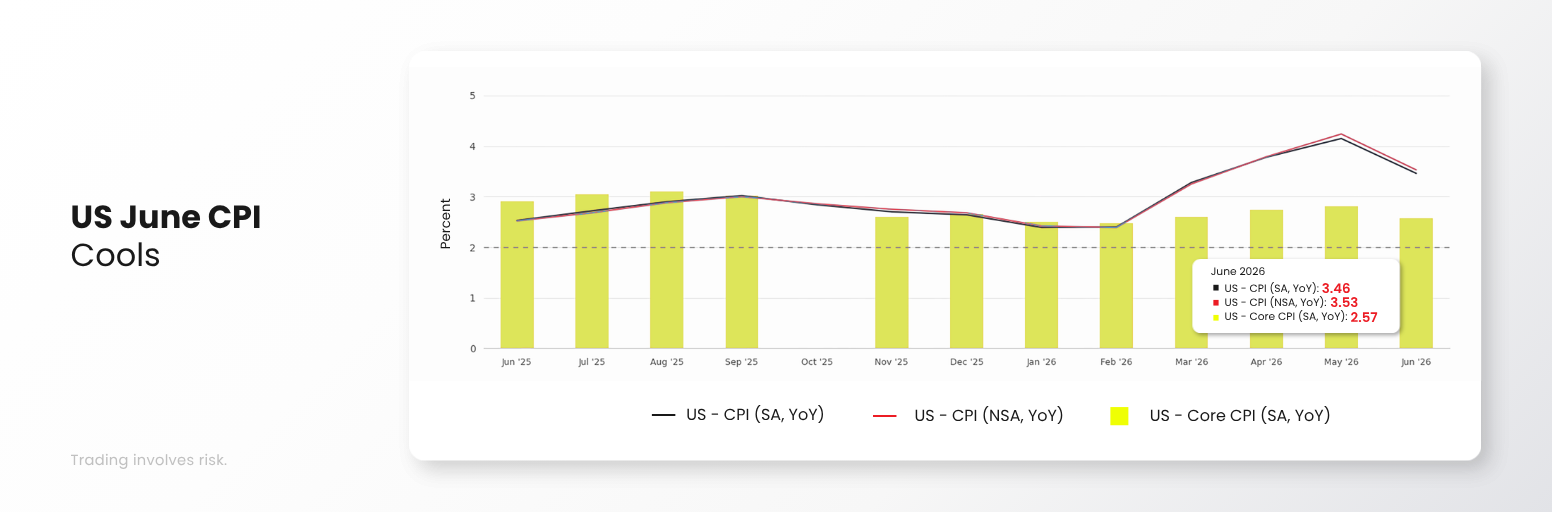
The actual reading came in at 3.46%, well below the market expectation of 3.8% and sharply lower than the previous reading of 4.17%.
That changed the mood.
Inflation is still a risk, but the latest CPI report suggests the market may be overpricing the probability of an aggressive Fed response.
When May non-farm payrolls were released, D Prime published “May 2026 Non-Farm Payrolls: Why the Jobs Beat May Not Trigger a Fed Hike,” arguing that rate hike expectations were too high. The same logic still applies today.
Even with renewed Middle East volatility and oil prices moving higher again, there may be no need for markets to panic too much about rate hikes.
What Could Push the Fed Toward a Rate Hike?
On July 17, the US and Iran tore up their agreement and conflict resumed.
It happened over the weekend, so many traders expected risk assets to fall when markets reopened on Monday. But when Asian markets opened, S&P 500 futures edged higher instead of falling.
That reaction says something important.
Markets may be becoming less sensitive to inflation shocks.
June CPI fell 0.4% month on month, marking the first negative reading in nearly six years. Core inflation also cooled. Core goods prices fell 0.1% month on month, core services prices were flat, and housing prices recorded zero month-on-month growth, the slowest pace since January 2021.
This matters because the decline in inflation was not only about energy.
Goods, housing, and non-housing services all cooled to different degrees. In other words, the disinflation trend is becoming broader.
For the Fed, two questions matter most:
Can oil prices stay under control?
Will inflation spread from energy into core goods, services, and wages?
If oil spikes sharply and inflation spreads into the broader economy, the Fed may be forced to act. But if oil remains contained and core inflation keeps cooling, the case for an immediate rate hike becomes weaker.
Warsh Sounds Hawkish, But the Fed May Still Wait
At his first congressional hearing, Fed Chair Kevin Warsh emphasized that the Fed has “zero tolerance” for inflation.
That sounds hawkish.
But importantly, he did not give a clear signal on the next step for interest rates.
That is not surprising. Monetary policy cannot directly control oil prices. If inflation is mainly driven by geopolitical shocks and energy prices, the Fed may choose to wait and see whether the pressure spreads into the wider economy.
Warsh is also focused on rebuilding the Fed’s policy framework. He has pushed forward five reforms through five working groups:
Monetary Policy Communication Team
Aims to reduce forward guidance, increase policy flexibility, and allow faster reactions to changing data.
Balance Sheet Working Group
Oversees balance sheet reduction.
Economic Data Working Group
Looks for higher-frequency and more accurate data to improve the quality and timeliness of official economic indicators.
Productivity and Employment Working Group
Studies the impact of AI on the economy and whether productivity gains can help absorb inflation.
Inflation Framework Working Group
Explores a broader set of inflation indicators.
Before this new framework is fully implemented, the Fed is unlikely to make a major policy shift too quickly.
Once the framework launches, policy may become more decisive. But before then, Warsh’s public communication may remain uncertain, with less forward guidance and more reliance on incoming data.
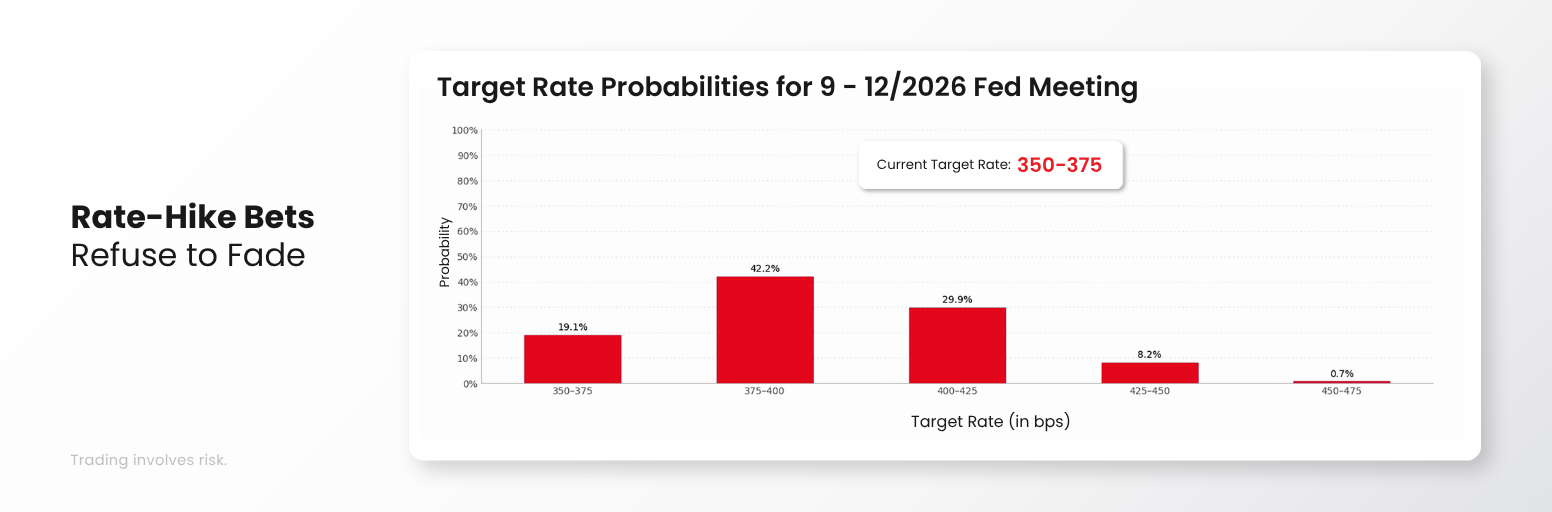
For now, the market generally expects no rate hike in July. However, traders are still pricing in at least one hike before year-end. The probability of rates staying unchanged through the end of the year is only 19.1%.
Warsh Does Not Control the Fed Alone
Warsh often talks tough on inflation, but he does not have full control over Fed policy.
The Federal Open Market Committee, or FOMC, leads monetary policy decisions. The Fed Chair can shape the agenda and influence communication, but when it comes to voting, Warsh only has one vote.
That matters.
Former Fed Chair Jerome Powell has not left the Fed. He remains one of the seven members of the Fed Board of Governors. Three other members are Democrats nominated by Biden. Another Republican member, Christopher Waller, was once a top candidate for Fed Chair and was also Warsh’s competitor.
That means Warsh may not have a strong majority behind him.
The only member likely to strongly support him is Vice Chair for Supervision Michelle Bowman. As a result, Warsh’s influence inside the committee may be relatively limited over the next two years.
This is another reason why an immediate aggressive rate hike cycle may be less likely than markets expect.
Why Warsh May Look to the Greenspan Playbook
Among former Fed chairs, Warsh often mentions Alan Greenspan.
That is important.
The Greenspan era coincided with the internet technology revolution, which lifted productivity, helped absorb inflation, and delayed the need for rate hikes. In 1996, Greenspan opposed rate hikes because he believed productivity gains could help contain inflation.
In hindsight, inflation did not continue rising at that time.
Warsh took office during another major technology shift: the AI revolution. He may hope that AI can play a similar role by boosting productivity and reducing inflation pressure.
But today’s situation is not exactly the same as the 1990s.
AI may improve productivity over time, but it may take years before those gains fully appear across the service sector. Current research shows that some US companies are using AI tools more frequently to cut costs and improve efficiency, but the share of jobs directly affected by AI is still not high.
Companies currently seem more willing to train existing employees in AI-related skills than to lay off workers and replace them.
That means the US service-sector labor market may remain relatively stable in the short to medium term. The supply side may improve gradually, but not fast enough to become the main driver of the economy right now.
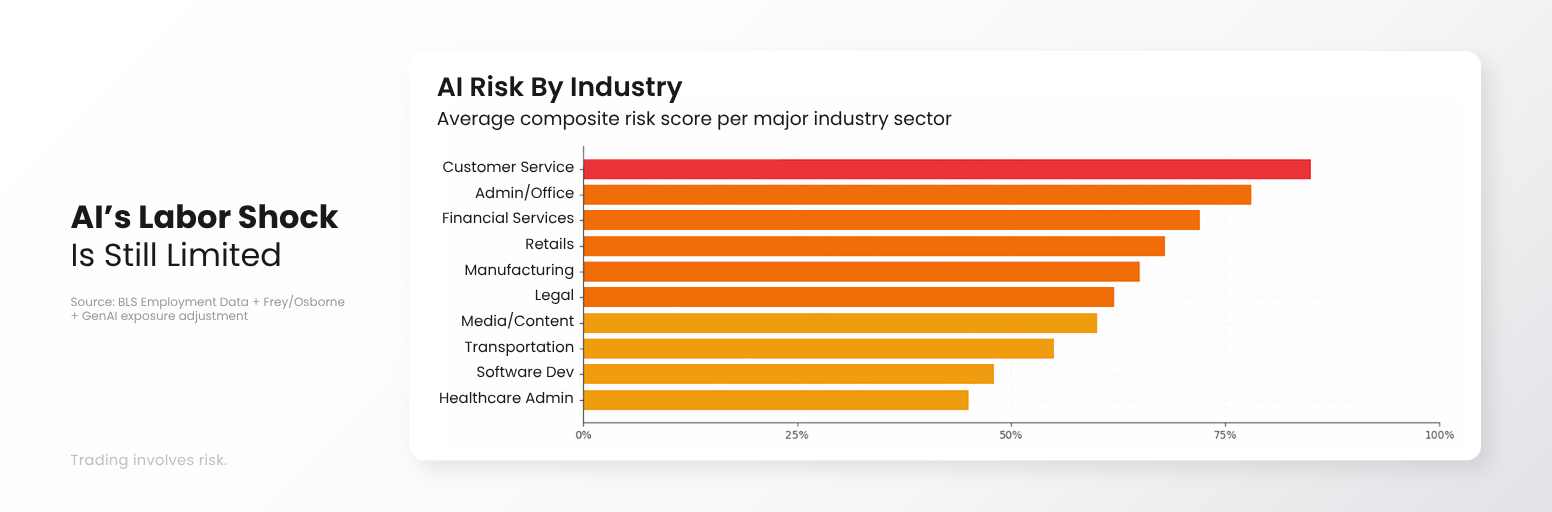
So even if Warsh wants to use Greenspan’s 1996 logic to delay rate hikes, he may struggle to convince other FOMC members to make a major shift.
That applies to both hikes and cuts.
The Bond Market Has Already Tightened Conditions
Another reason rate hike expectations may be overblown is simple:
The market has already raised rates.
Since February, the US 2-year Treasury yield has risen by around 75 basis points and is now close to 4.2%.
That is far above the Fed’s current policy rate range of 3.5% to 3.75%.
This matters because higher Treasury yields raise financing costs across the economy, including mortgages and other loans. In practice, the bond market has already applied the brakes.
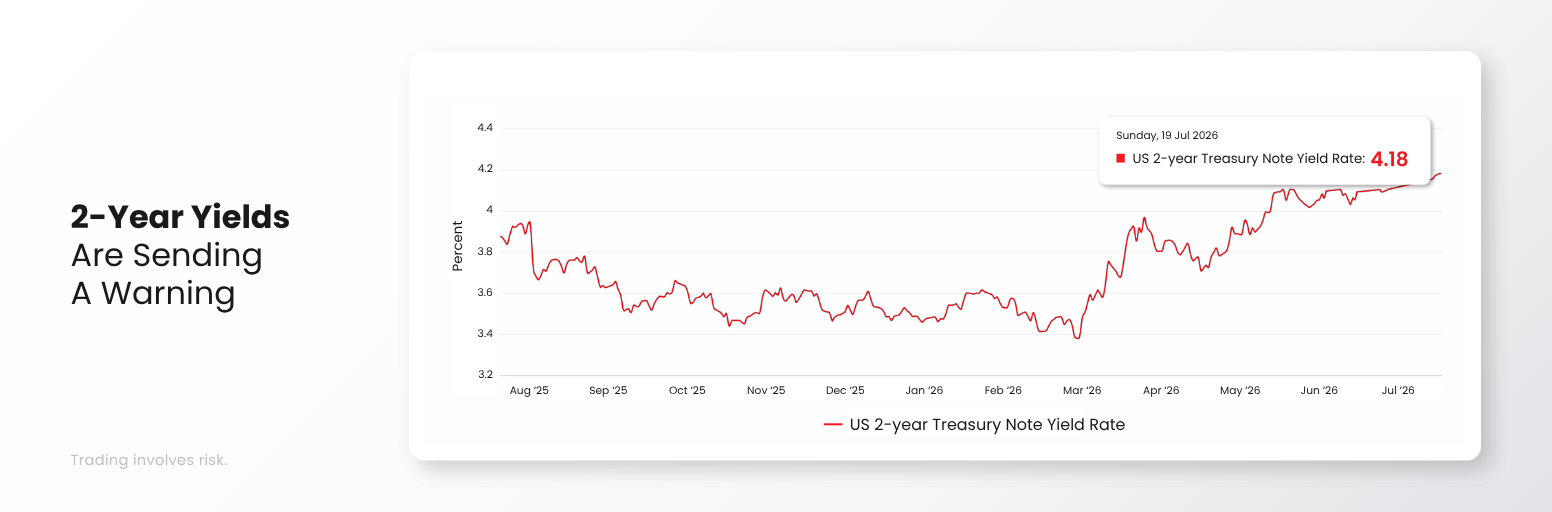
Short-term yields have risen. Capital has flowed into bonds. Liquidity has tightened.
In other words, the market has already completed a quiet “rate hike” without the Fed needing to move.
That gives Warsh room to wait and observe how the economy reacts.
What Happens Next?
Rate hike expectations still dominate the market, but the picture is not one-sided.
After the last rate cut in December 2025, the Fed has kept rates unchanged. Since then, the labor market has rebounded from its February low, while the Trump administration’s military action against Iran triggered an inflation shock.
That caused the earlier rate-cut narrative to collapse.
But the latest CPI data changes the balance again.
Inflation is cooling more broadly. Oil prices remain the key risk, but the market has not panicked despite renewed US-Iran tensions. The Fed is still rebuilding its policy framework. Warsh does not fully control the FOMC. The bond market has already tightened financial conditions.
That makes a near-term rate hike less certain.
D Prime believes the possibility of a rate hike this year remains real, especially if oil prices surge again or inflation spreads into wages, goods, and services.
However, D Prime remains cautious about expecting rate hikes in July or September.
The Fed will need clearer evidence before acting, especially with elections approaching and political pressure increasing.
Rate Hike Fear May Be Running Ahead of the Data
The market is right to watch inflation.
But it may be moving too fast on rate hike expectations.
June CPI came in cooler than expected, with price declines spreading beyond energy. Warsh sounds hawkish, but the Fed’s new framework is still being built. The FOMC remains divided, and the bond market has already tightened conditions through higher short-term yields.
For traders, the key is not just whether inflation rises.
The real question is whether inflation becomes broad enough and persistent enough to force the Fed’s hand.
For now, that case is not yet clear.
Oil still matters. Data still matters. But panic over immediate rate hikes may be premature.
The Fed may still hike later this year.
But in the third quarter, the stronger case may be patience.
By D Prime Analysis Team
Macro and market strategy research by D Prime’s in-house analysis team.
Disclaimer
The information contained herein is provided for general informational and educational purposes only and does not constitute investment advice, financial advice, trading advice or any other form of professional advice, a recommendation, or an offer or solicitation to buy or sell any financial instruments or engage in any trading strategy.
Trading in leveraged products such as contracts for difference (CFDs) involves a significant risk of loss and may not be suitable for all investors. Past performance is not indicative of future results. Any references to market trends, asset performance, price levels, or forward-looking statements reflect opinions or general market commentary as at the date of publication and are subject to change without notice.
This article does not take into account any individual investor’s objectives, financial situation, or risk tolerance. Readers should conduct their own independent research and seek professional advice before making any investment or trading decisions. D Prime and its affiliates make no representations or warranties about the accuracy or completeness or reliability of this information and disclaim any and all liability for any direct, indirect, incidental, consequential, or other losses or damages arising out of or in connection with the use of or reliance on any information contained herein. The above information should not be used or considered as the basis for any trading decisions or as an invitation to engage in any transaction. Do not rely on this article to replace your independent judgment.
“D Prime” is a brand name of D Prime Vanuatu Limited, a company incorporated and regulated by the Vanuatu Financial Services Commission (Company Number: 700238). The availability of products and services may vary depending on jurisdiction and applicable regulatory requirements.